
Welcome!
About SIHS
Thanks for visiting the Squirrel Island Historical Society website. The Historical Society was incorporated in 1995 after five years as the ‘Squirrel Island Historical Commission.’ Our mission is to a) develop, promote, and augment understanding and interest in the history of the society’s geographical area of Squirrel Island, ME and the surrounding area, and b) stimulate awareness and preservation of local historical, cultural and architectural assets and resources. In pursuit of our mission we acquire and preserve historical records and artifacts, host community events, offer internships to young islanders, and present yearly exhibitions.
An annual donation of $1 or greater grants membership to SIHS for that year. Donations to the Squirrel Island Historical Society are tax-deductible and may be sent to Joan Guild, SIHS Co-Treasurer, at: P.O. Box 3, Cumberland, ME 04021 (winter) or General Delivery, Squirrel Island, ME 04570 (summer).
2026-2027 Trustees: Laurie Gourley (Chair), Anne Spencer, Avis Bohlen, Chan Reis, Jen Cartmell, Lee Connor, T.R. Kidder.
Officers: Niesa Ryder (Executive Director), Tom Pears (Executive Director Emeritus), Rod McIlwain (Treasurer), Joan Guild (Secretary and Co-Treasurer), Joanna LeGore (Co-Treasurer).
Squirrel Island: An Illustrated Timeline
The earliest written reference to “Squirrill” that we’re aware of was made in 1687. By the 1780s, Squirrel was owned by Andrew Reed, a “gentleman of Boothbay.” He conveyed it to the brothers Samuel, John, and Levi Ball. Samuel took sole ownership in 1797. He died in 1803 and “most of the island was sold to his son-in-law; Amos Gray, to cover debts; the northwest corner was dower land for Samuel’s widow” (Islands of the Mid-Maine Coast, Charles McLane 1994).
According to Islands of the Mid-Maine Coast (referring to public records), the Grays “farmed the island for two decades – they appear in the 1810 census with a household of ten (6/4) – and then sold in 1824 to William Greenleaf of Starks (Somerset County) for $1,000.” Local lore suggests that the island was traded for Greenleaf’s farm in Starks.
The historian William D. Williamson states in The History of the State of Maine (Volume 1: pg 55, published 1832) that Squirrel “is inhabited by three families and is a noted place for its abundance of white sand.” Based on this claim, McLane suggests that “it is possible the residences of Grays and Greenleafs overlapped.” Greenleaf resided on the Island until his death in 1868.
Pre- and Post-European settlement, Abenaki (aka Wabanaki) people would stop seasonally at Squirrel to camp and fish on their way up and down the coast. Reference was made in the Squid to this occurring on the North End during Gray’s time on the Island.
1870 THROUGH 1900
July 21, 1870: Following a camping trip to the Island, J.B. Ham and others from Augusta purchased the Island from Greenleaf’s heirs for $2200. The sale included two farmhouses (one where the current farmhouse stands, a second by the Gunn cottage) as well as the sheep and lambs.
February 3, 1871: A charter was obtained from the Maine Legislature to form the Squirrel Island Association.
June 22, 1871: A group primarily coming from Lewiston and Augusta met on the Island for an auction of lot choice – the first choice bid was made by the Chase brothers for seven dollars. When the group arrived to the Island they landed on Indian Beach as the wharf, which had been started that Spring, was still under construction.
1871: There were twelve cottages built during Squirrel’s first season as a summer colony. Of the original twelve, only four have not been entirely replaced or otherwise destroyed. The wharf and store were constructed at some point during this year. The store remained a staple of Island life for nearly 100 years, having been removed in 1970.
1872: The Squirrel colony “more than doubled”, with many cottages appearing on The Paw. This year also saw the construction of the first public building on the Island – a bowling alley and meeting room on the site of the Library. (CLICK HERE to read an account in the Boston Journal of a trip to the Island in 1874)
1876: Squirrel’s first and longest lasting newspaper, The Squirrel Island Squid, began publication in 1876 on the porch of the Frank Dingley cottage, which burned in the 1940s, (CLICK HERE to read Squid Volume 1).


1877: The Squid Office was built just below the Dingley cottage and would serve as the printing house for the Squid for the next 14 years. The Reading Room (now known as the Post Office) was also built this year and is now the oldest public building still standing on the Island. (CLICK HERE to read the first description of the Reading Room from the July 7, 1877 Squid.)
1879-1880: The Chapel was built toward the end of 1879 and was formally dedicated in 1880. By 1880 there were nearly 80 cottages on the Island.


1883: The original Farmhouse on the field was replaced by the one we know today.
1884: The Ladies Improvement Association was founded.
1888: A.H. Davenport built Tweedle Dee (moved to Boothbay Harbor in the 1920s) and Tweedle Dum (known as Stork Club today), which marks the beginning of Davenport’s architectural contributions to the Island.
1890: The Ladies Improvement Association spearheaded the construction of the Casino on the spot of the old meeting room and bowling alley. The Casino would remain a major factor in the social life of the Island for nearly 75 years. The Freight Shed was also built this year, replacing a smaller earlier structure. (CLICK HERE for the original description of the Freight Shed building).


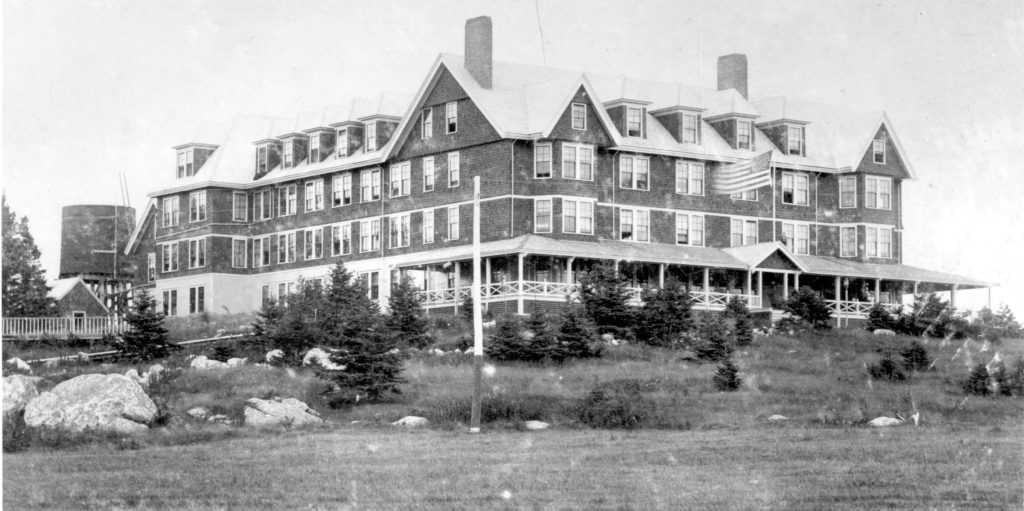
1893: Squirrel’s first major devastation by fire occurred in September of 1893 when the Chase House, a boarding house turned Squirrel’s first hotel, along with seven or eight private cottages, burned down on the hill above Hotel Beach. This year also saw a telegraph cable laid from Spruce Point.
1895: The Hotel Eastern opens on the spot of the Chase House. By the following year, due to complaints from Islanders, the name had changed to Squirrel Inn.
1890s Newspapers: The Squid was discontinued following the 1891 season after fifteen summers of (at least) weekly publication. Throughout the 1890s Squirrel saw attempts at a number of other publications, namely the Buoy (in 1893 and 1895), the Beacon (in 1896 and 1899) and the Tattler (1898), but none achieved the longevity of the Squid.

1900s THROUGH 1950s
1900-01: The Spa (later known as the Tea Shop) was built by Davenport, replacing Mrs. Fickett’s ice cream parlor and restaurant on the corner across from the Post Office.
1903: The Squirrel Island Village Corporation was formed, allowing for a certain degree of municipal separation from Southport.
1904: Davenport built the Library, which was dedicated on August 13.
By 1906: Water pipes are laid from the Harbor.
1915: The Chapel’s steeple was rebuilt to the one we recognize today.


1919: The Hennessy Five Star Orchestra, which still performs every August, was born (at this point under a different name – it would be casually named the Hennessy Five Star Orchestra in 1920).
1920: Electricity comes to Squirrel.
1921: Squirrel celebrated its 50th anniversary as a summer colony with a pageant. The anniversary was also commemorated by an issue in the Lewiston Evening Journal, detailing many aspects of Island life up to that point. By this year there were 123 cottages on the Island. You can find the LEJ issue on the All-Island History page HERE.
1930: There are over 120 cottages on the Island.
1932: Squirrel was devastated by fire once again when five cottages burned in the Row Fire.
1933: The Nellie G. II was launched.
1937: The first Frank Hughes Day takes place with a photograph taken on the “Island Spa” steps.
1934: The horse “Prince” was replaced by a tractor.
1942: After nearly 50 years without an Island newspaper, a one-time issue of the Squirrel Island Squid is printed, edited by Wilder Hobson.
1940s War-Time Squirrel: The Island saw a dramatic decrease in population in the early 1940s, with upwards of 30 to 40 cottages being unoccupied during war-time summers.
1960s THROUGH THE PRESENT
1962: Squirrel is hit by fire once again. The Squirrel Inn along with several outbuildings burns in late September. This was also Squirrel’s last summer hosting the Northern New England Tennis Championships.
1964: The Lacy Cottage (on the lot of the Big Farrington cottage) burned down in the Summer and a volunteer fire department was organized.


1965: The Casino burned down the day after the Fete Ball in late August. On November 18, the Tea Shop and neighboring Thomson cottage were also taken by fire.
1967: The new Town Hall and Tea Shop were built on the land of the previous Tea Shop and Thomson cottage.


1970-71: The Squirrel Island Store is razed over the off season.
1983: The Squid was reborn, with yearly publications maintained until 2013.
1986: In June the old barn on the East Shore burned. The Chapel garden and rock circle was built.


1988-89: The Maintenance Garage was built in 1988. The Ice Cream Corner was added to the Tea Shop and the deck around the Town Hall and Tea Shop was enlarged.
1995: The Squirrel Island Historical Society was incorporated (formerly Squirrel Island Historical Commission from 1990).
1996: The Novelty is launched, replacing the Maranbo II as Squirrel’s ferry.
2000: “SOAP” (Squirrel Outdoor Activities Program) was started.
2006: The Duck Shed was built.
2007: The Children’s Room at the Library was renovated.
2011: The tennis courts saw a major renovation.
2012: The Community Garden was established on the North End.
2015: The Town Hall and Tea Shop renovation took place over the Winter.
2021: Squirrel celebrated 150 years as a summer colony.
2023: The Maintenance Garage burned down in November.
Returning User Login
Our full website requires an account to access – click “Click here to register” below to create an account if you have not already done so. Returning users may log in here.
New user? Click here to register.

You must be logged in to post a comment.